POSMall: A Free PostgreSQL-first eCommerce Plugin and Theme for October CMS
I have completed an important development stage for POSMall and released it publicly. POSMall is now available as a free eCommerce plugin for October CMS, together with a separate visual storefront theme for the customer-facing part of the store.
For me, this is not just experimental code or a small technical demo. I brought the product to a point where I am ready to use it myself in real projects: for product catalogs, services, virtual products, checkout, orders, taxes, API integrations, and future eCommerce development.
POSMall is published on the October CMS Marketplace as a free plugin for October CMS v4.x, and POSMall Theme is published separately as a free eCommerce theme. The plugin provides the backend and business logic of the store, while the theme provides the visual storefront layer.
What is POSMall?
POSMall is an eCommerce engine for October CMS. It provides the business logic layer of the store.
- product catalog;
- categories, brands, and properties;
- physical, virtual, and service products;
- prices, stock, and warehouse structure;
- vendors, channels, and warehouses;
- cart and checkout;
- orders, statuses, payments, and shipping;
- tax rules;
- reviews and customer-facing workflows;
- REST API;
- GraphQL-ready architecture.
POSMall Theme is a separate visual storefront theme. It is responsible for the public website experience: catalog pages, product pages, service pages, cart, checkout, customer account pages, payment links, privacy pages, and terms pages.
The important part is that the theme does not replace the plugin. The plugin owns the eCommerce backend logic, while the theme displays the storefront and uses POSMall components.
Why PostgreSQL-first?
The main technical idea behind POSMall is not simply to “make an online store.” The goal is to build an eCommerce core that works well with PostgreSQL from the beginning.
Many older PHP eCommerce systems were historically built around MySQL. POSMall takes a different direction: PostgreSQL-first catalog architecture, fast read models, indexes, filtering, search, tax lookup workflows, and predictable catalog behavior on larger datasets.
Local Benchmark Checkpoint
In a local production-like warm benchmark on 300k products, POSMall showed:
| Category page | 33.49 ms |
| Filtered page | 33.79 ms |
| PostgreSQL DB category segment | 0.72 ms |
| PostgreSQL DB filtered segment | 1.89 ms |
These numbers are not a universal performance guarantee for every server or project. They are a local benchmark checkpoint showing the direction of the architecture: PostgreSQL is not the bottleneck, and the catalog can remain fast even on larger datasets.
Project Architecture
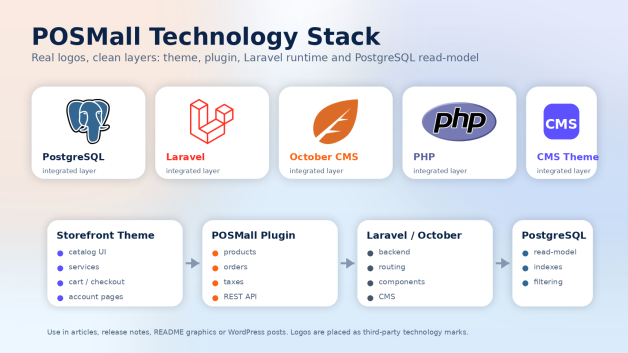
Architecturally, POSMall is divided into several layers.
1. POSMall Plugin
This is the main eCommerce backend. It contains models, migrations, backend sections, settings, business rules, API structure, tax module, checkout and order foundations, and a PostgreSQL-oriented catalog layer.
2. POSMall Theme
This is the storefront layer. It is responsible for the visual part of the store and the pages customers interact with. The theme connects to POSMall business logic, but it does not try to store or duplicate commerce data.
3. PostgreSQL Read Model
This layer helps the catalog work quickly with products, categories, filters, search, and large lists. The goal is not to pull heavy ORM relations on every request, but to use a prepared structure for fast public pages.
4. REST API and GraphQL-ready Direction
The REST API is useful for integrations, external storefronts, automation, customer accounts, POS scenarios, and future headless use cases. The GraphQL layer is part of the future direction, so commerce data can be requested flexibly by storefronts, admin tools, and external systems.
What Has Been Built
During development, I built more than just a product catalog. POSMall now has the foundation of a real eCommerce platform.
products, categories, brands, properties, services, and virtual products
vendors, channels, warehouses, currencies, and price categories
payment gateways, payment methods, shipping methods, and order states
REST API documentation, API token scopes, and GraphQL-ready architecture
One of the important parts is the tax logic. POSMall supports manual tax rules and a source-backed USA tax helper workflow. At the same time, I intentionally keep the legal position clear: POSMall can help prepare and apply tax data, but store owners remain responsible for verifying tax compliance with official sources or qualified professionals.
Why I Am Ready to Use It Myself
I believe POSMall has moved from “technical experiment” to “something that can be used and developed further.”
First, the architecture is clear. There is a separate plugin for business logic and a separate theme for the storefront. This is much cleaner than mixing eCommerce logic, design, checkout, API, and backend administration into one inseparable mass.
Second, catalog performance already looks strong. In a local production-like run, POSMall keeps category and filtered pages fast even with 300k products. That means the next stage should not be only about shaving off a few more milliseconds. The real work now is product completeness: documentation, UX, API, checkout, analytics, roles, import/export, and integrations.
Third, I own the code and can keep developing it. This matters. In eCommerce, there is almost no such thing as a perfect universal solution. Every store eventually needs its own processes, rules, integrations, reports, and business logic. POSMall is designed to be extended and adapted.
What Comes Next
The next stage is not about adding features just for the sake of having a longer feature list. I want to develop POSMall as a practical eCommerce tool for October CMS.
- improve documentation;
- expand the REST API;
- bring the GraphQL approach to a stable state;
- improve checkout and order lifecycle;
- add more production-oriented tests;
- improve analytics and dashboard workflows;
- enhance import and export tools;
- develop POS and warehouse scenarios;
- make the product easier for developers and store owners to use.
Right now, I see POSMall as a free foundation for people who want an October CMS eCommerce stack with PostgreSQL, Laravel runtime, clean architecture, and the ability to customize it for real business needs.
Links
POSMall Plugin:
https://octobercms.com/plugin/kodzero-posmall
POSMall Theme:
https://octobercms.com/theme/kodzero-posmalltheme
GitHub Plugin:
https://github.com/TjoBiZ/POSMall
GitHub Theme:
https://github.com/TjoBiZ/POSMallTheme
